


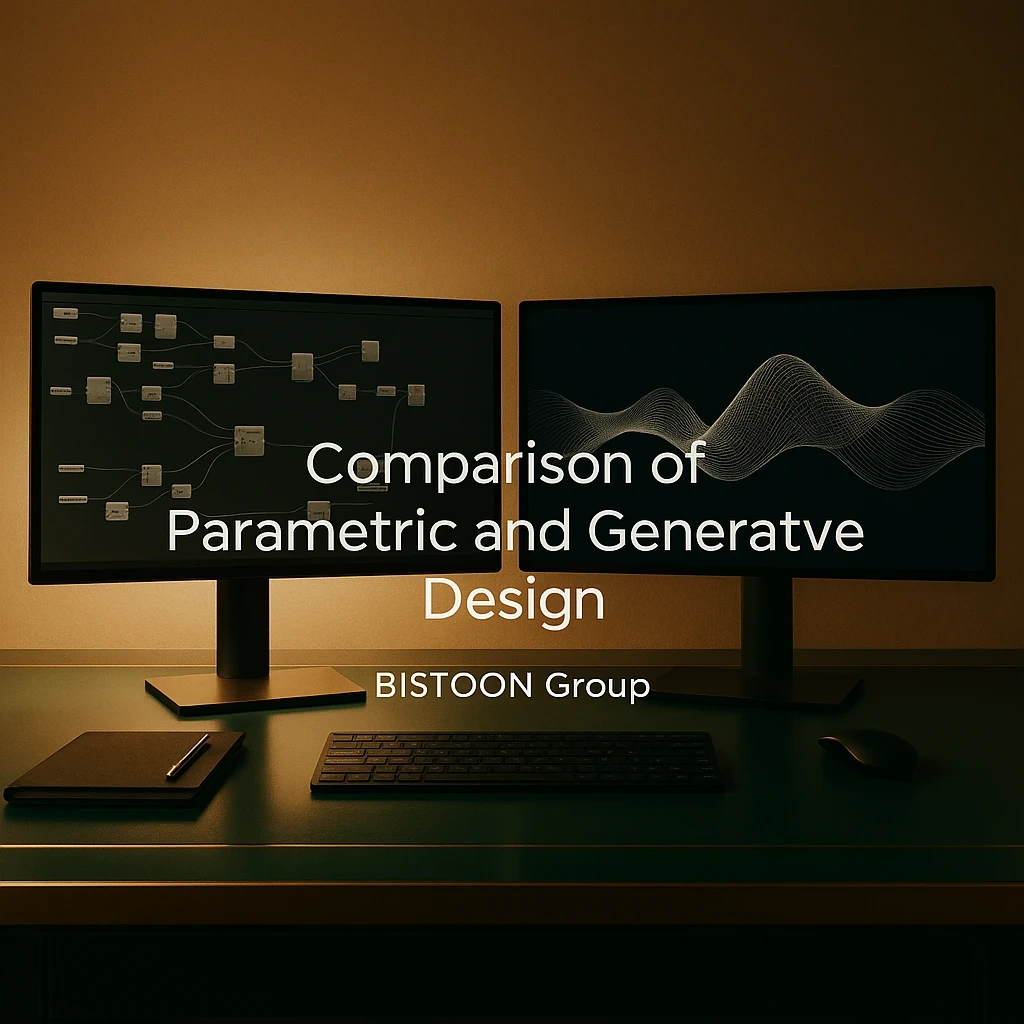
Comparison of Parametric and Generative Design — Beyond Geometry
Introduction
Digital design tools keep transforming architecture in the twenty‑first century. What once focused on abstract geometry has become a dialogue between intelligence, system behavior, and spatial experience.
Today, architects do not simply draw buildings; instead, they design codes that let buildings emerge.
Within this new paradigm, parametric and generative design stand as two essential methodologies. Both rely on computation and algorithmic thinking. Yet they differ in spirit: one centers on control, while the other embraces evolution.
This article reveals their contrasts, their shared ground, and their ability to rise beyond geometry—toward an emotional and intelligent architecture. It also presents how BISTOON Group transforms these methods to craft what we call Luxury Realism within Context.
1 — Parametric Design: Geometry Under Control
Parametric design was born from the need to manage complexity. It builds a system where parameters—numbers and relationships—govern the geometry.
The method’s strength comes from its precision. Through tools such as Grasshopper for Rhino or Dynamo for Revit, designers define how one variable shapes another. When a ratio or angle changes, the entire model updates instantly.
Patrick Schumacher’s theory of Parametricism sees architecture as a fluid field formed by algorithmic dependencies. Zaha Hadid Architects, for instance, made this language iconic: expressive and deeply mathematical.
However, parametric design often stays trapped inside geometry. It mirrors logic rather than process. Architects still author the system; the computer only executes it.
In essence, parametric design means control. It lets architects handle complexity but still inside boundaries they set.
2 — Generative Design: Intelligence in Process
Generative design moves further. It introduces system intelligence instead of geometric dependency. Here, architects define objectives rather than relationships, and then the system evolves many possible solutions toward those goals.
By combining AI, machine learning, and evolutionary algorithms, generative systems learn and optimize. They adapt based on performance, environment, material efficiency, and human behavior.
Unlike parametric tools that produce one exact model, generative processes create thousands. Each variation grows through mutation and selection guided by fitness values. Consequently, the architect becomes a curator—guiding evolution rather than forcing form.
Parametric models describe how things change, while generative models explore why they change.
Tools such as Autodesk Generative Design, Hypar, or AI‑based solvers now let architecture behave like a living ecology. Geometry adjusts through daylight, airflow, or thermal comfort, not only through formal logic.
This approach transforms design into a narrative of emergence. The architect sets intent; the outcome embodies performance and context.
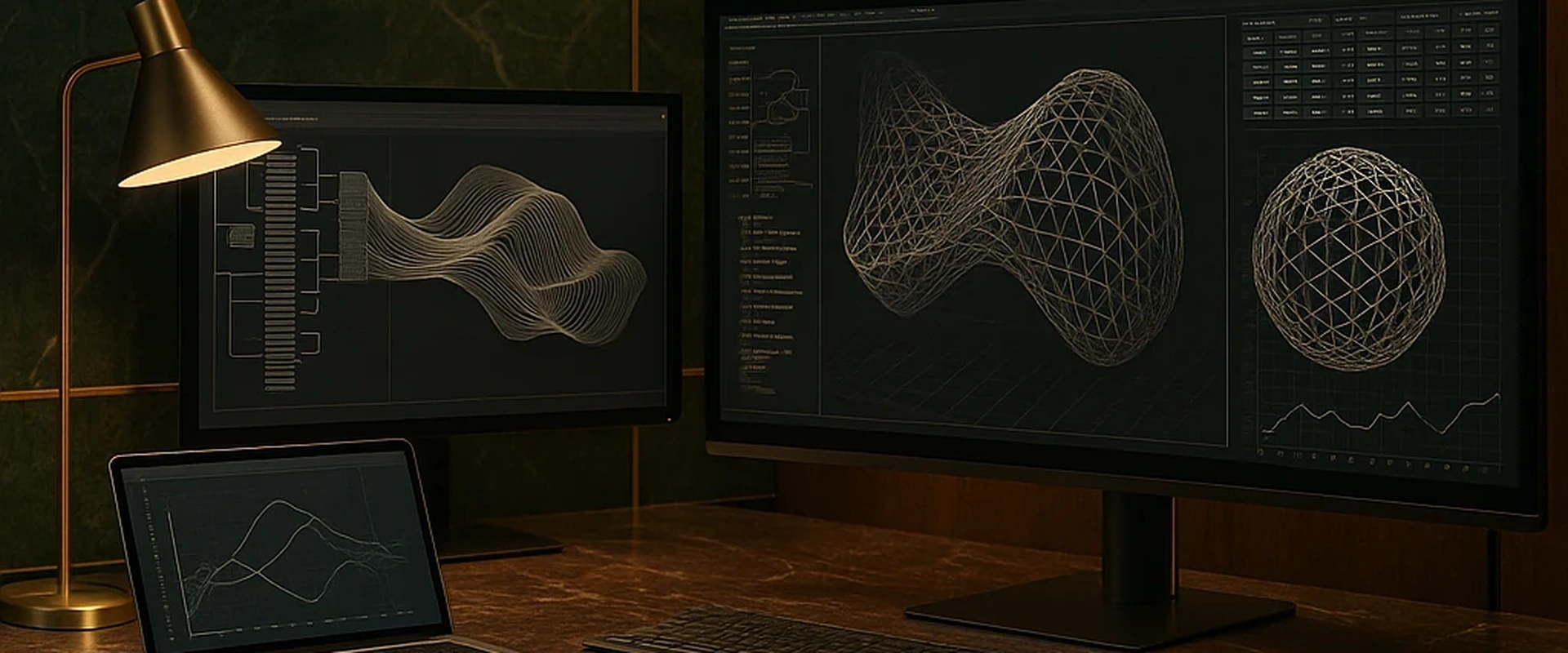
3 — Comparative Fram
Comparative Framework — Beyond Geometry
Dimension: Core Logic
Parametric Design: Geometric parameters and dependencies
Generative Design: Evolutionary search, AI, adaptive systems
Dimension: Goal
Parametric Design: Controlled variation and precision
Generative Design: Performance-based emergence and adaptability
Dimension: Designer’s Role
Parametric Design: Author controlling geometry
Generative Design: Guide defining intentions and behavioral rules
Dimension: Primary Tools
Parametric Design: Rhino / Grasshopper / Revit Dynamo
Generative Design: AI engines / Generative algorithms / Machine Learning
Dimension: Output Nature
Parametric Design: Deterministic, predictable
Generative Design: Self-evolving, multiple outcomes
Dimension: Philosophical Focus
Parametric Design: Optimization through form
Generative Design: Optimization through performance
Dimension: Human Interaction
Parametric Design: Manual adjustment of parameters
Generative Design: Automated evolution guided by data feedback
In summary, parametric design relies on parameters to produce geometry; generative design relies on objectives to produce intelligence. Where one manipulates, the other mutates.
This distinction is not only technical but also philosophical. Generative design introduces an ethical dimension to architecture—spaces that learn, respond, and adapt rather than simply represent.
4 — From Geometry to Meaning: The New Aesthetic of Intelligence
As architecture enters the age of AI, beauty is no longer visual alone. A project becomes meaningful when it performs intelligently and emotionally within its context.
At BISTOON Group, we call this shift Luxury Realism within Context. Luxury, for us, is not decoration—it is experience. It arises when spatial systems communicate naturally with human presence.
Generative principles allow the creation of context‑aware luxury. For instance, a daylight‑optimized façade lowers energy demand and creates rhythm and emotional harmony.
The goal is synchrony, not ornament. Through generative logic, a space turns into an ecosystem where material, texture, and geometry respond to users dynamically.
Thus, moving beyond geometry means approaching authentic meaning—architecture guided by empathy, sustainability, and intelligence.
5 — BISTOON Projects: Integrating Systems of Intelligence
At BISTOON Group, parametric and generative design work together, not against each other. Parametrics structure ideas; generatives let those ideas evolve.
The firm’s ZRRP‑12 Framework merges these logics across twelve layers—from digital morphogenesis to light behavior—ensuring each design remains both performative and human‑centered.
- Taban Shahr Residence: façade optimization driven by climatic data.
- Molla Sadra Apartment: AI‑based spatial zoning that adapts to daily patterns.
- Dr. Mahmoudi Clinic: material mapping connecting texture to user emotion.
Every project reflects BISTOON’s conviction that the future of luxury lies in realism with reason—spaces where algorithmic intelligence meets material warmth.
6 — Designing with Machines: A Philosophical Shift
Generative design redefines authorship. Instead of commanding the computer, the architect collaborates with it.
Parameters become intentions—comfort ranges, light gradients, acoustic behavior—and algorithms explore possibilities within those bounds.
This partnership brings ecological intelligence. In BISTOON’s studios, simulations predict how spaces react to stress, movement, or light. Hence, every curve and junction serves a measurable purpose.
The more systems learn, the more architects must act as ethicists—bridging machine logic with human emotion.

7 — Future Design: Emergent Systems and Living Buildings
In the near future, architecture, data science, and biology will overlap. The next stage—co‑evolutionary design—will let structures keep adapting after occupation.
Imagine façades that learn from residents, reshaping for comfort; interiors tuning acoustics based on activity.
BISTOON invests in this vision through research connecting AI‑ethics and sensory realism. The destination is living architecture—buildings that feel and evolve.
Conclusion: Beyond Geometry into Conscious Design
Ultimately, the difference between parametric and generative design is ontological. One manipulates geometry; the other cultivates life.
Parametricism offers precision; generative design adds autonomy, intelligence, and emotion.
Modern architects stand between both approaches—coding order while curating emergence. Their balance sparks the new realism: architecture not drawn but grown.
Through Luxury Realism within Context, BISTOON Group bridges technology and tactility. It defines design as an encounter between intelligence, craftsmanship, and narrative clarity.
The story of architecture, therefore, moves beyond geometry—toward meaningful intelligence expressed in every surface and shadow.